";?>
To summarize, calculations using binomial trees for the stockmarket can be
organized as follows
- Divide the entire lifetime of the option into a finite number of
steps N, ranging from only a few (by hand) up to 30 (using a computer
to evaluate 31 possible outcomes that are connected with 230~ 1 billion possible paths).
- Forecast the underlying forward in time (trunk
 leaves),
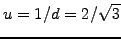
choosing (u,d) according to (3.2#eq.4) to reproduce the historical
volatility observed in a real market.
leaves),
choosing (u,d) according to (3.2#eq.4) to reproduce the historical
volatility observed in a real market.
- Work backward in time (trunk
 leaves) starting from the
terminal option payoff; for every neighboring branching point, calculate
the hedging delta (3.2#eq.1) and the option price at the
previous time step (3.2#eq.3).
In the case of American options, substitute the (larger)
intrinsic value
that can be obtained from an early exercise when the calculated price
drops below this intrinsic value.
leaves) starting from the
terminal option payoff; for every neighboring branching point, calculate
the hedging delta (3.2#eq.1) and the option price at the
previous time step (3.2#eq.3).
In the case of American options, substitute the (larger)
intrinsic value
that can be obtained from an early exercise when the calculated price
drops below this intrinsic value.
- The final result is obtained on the trunk of the tree and is an
approximation of the fair value of the option before the expiry date,
with an accuracy proportional to 230.
Because it involves only simple mathematics, binomial trees are ideally
suited to develop an intuition for option pricing (exercise 3.01, 3.02).
Some practitioners even use trees to evaluate option prices with a computer:
the forthcoming sections will show that differential calculus provides a far
better framework to account for the features appearing in exotic contracts.
Indeed, without having to account for these features, the computer is not
really needed: the price can simply be calculated from an analytic solution
of the Black-Scholes differential equation, which we are about to derive.
SYLLABUS Previous: 3.1 Option pricing for
Up: 3 FORECASTING WITH UNCERTAINTY
Next: 3.3 Improved model using


 ','..','$myPermit') ?>
SYLLABUS Previous: 3.1 Option pricing for
Up: 3 FORECASTING WITH UNCERTAINTY
Next: 3.3 Improved model using
','..','$myPermit') ?>
SYLLABUS Previous: 3.1 Option pricing for
Up: 3 FORECASTING WITH UNCERTAINTY
Next: 3.3 Improved model using

![\includegraphics[width=6cm]{figs/tree2.eps}](s3img58.gif)
 .
The time step
.
The time step
 has been adjusted so that two levels
span the entire lifetime of the option
has been adjusted so that two levels
span the entire lifetime of the option  .
More levels yield a more accurate result.
.
More levels yield a more accurate result.


![$\displaystyle \Lambda_0 = [p\Lambda_u +(1-p)\Lambda_d]\exp(-r\Delta t) \qquad\mathrm{with}\qquad p=\frac{\exp(r\Delta t)-d}{u-d}$](s3img61.gif)

![$\displaystyle E[S]=pS_0u -(1-p)S_0d = p(u-d)S_0 +S_0s = S_0\exp(r\Delta t)$](s3img63.gif)

![$\displaystyle \sigma^2\Delta t = qu^2 +(1-q)d^2 -[qu +(1-q)d]^2$](s3img65.gif)
