','..','$myPermit') ?>
SYLLABUS Previous: 4.3 Methods for European
Up: 4.3 Methods for European
Next: 4.3.2 Solution of the
','..','$myPermit') ?>
SYLLABUS Previous: 4.3 Methods for European
Up: 4.3 Methods for European
Next: 4.3.2 Solution of the

 in
3.3.1#eq.1) chosen to derive the Black-Scholes equation (3.4#eq.4)
shows that the asset price
in
3.3.1#eq.1) chosen to derive the Black-Scholes equation (3.4#eq.4)
shows that the asset price  and the time
  are in fact not a
natural choice of variables for the price of an option that expires
at a time
are in fact not a
natural choice of variables for the price of an option that expires
at a time  .
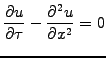
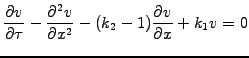
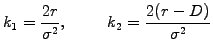
This motivates a transformation from financial variables
.
This motivates a transformation from financial variables  to log-normal variables
  defined by
![$ x \in [-\infty; \infty]$](s4img87.gif) ,
,  using boundary
 ,
,
 and initial
conditions
and initial
conditions  that have to be derived from no-arbitrage arguments
with financial variable
via the transformations (4.3.1#eq.1
and 4.3.1#eq.4).
.
that have to be derived from no-arbitrage arguments
with financial variable
via the transformations (4.3.1#eq.1
and 4.3.1#eq.4).
.
SYLLABUS Previous: 4.3 Methods for European Up: 4.3 Methods for European Next: 4.3.2 Solution of the

![$\displaystyle V=Kv=K\exp\left[-\frac{1}{2}(k_2-1)x -\left(\frac{1}{4}(k_2-1)^2 +k_1\right)\tau\right] u(x,\tau)$](s4img85.gif)