','..','$myPermit') ?>
SYLLABUS Previous: 6.2 Methods for American
Up: 6.2 Methods for American
Next: 6.2.2 Solution of the
','..','$myPermit') ?>
SYLLABUS Previous: 6.2 Methods for American
Up: 6.2 Methods for American
Next: 6.2.2 Solution of the

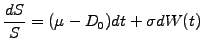
 , the random
walk for the underlying price increment (3.3.1#eq.1) is modified to
, the random
walk for the underlying price increment (3.3.1#eq.1) is modified to
 of shares and store the earnings from a dividend yield.
The initial value and the incremental change are
of shares and store the earnings from a dividend yield.
The initial value and the incremental change are
 as a function of the underlying, the random
component is again eliminated by continuously re-hedging the portfolio
with a number
as a function of the underlying, the random
component is again eliminated by continuously re-hedging the portfolio
with a number
 of shares.
No arbitrage arguments show that without taking any risk, the portfolio
can at most earn the risk-free return of the spot rate.
Because an American option can be exercised any time until it expires, the
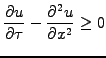
incremental change in the portfolio value satisfies the inequality
of shares.
No arbitrage arguments show that without taking any risk, the portfolio
can at most earn the risk-free return of the spot rate.
Because an American option can be exercised any time until it expires, the
incremental change in the portfolio value satisfies the inequality
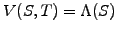 ,
this inequality (known in mathematics as an
obstacle problem)
must be supplemented by the free boundary condition
,
this inequality (known in mathematics as an
obstacle problem)
must be supplemented by the free boundary condition
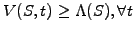 .
Apart from that, the Black-Scholes equation is the same for European
options paying a dividend with the strict equality here replaced by
an inequality.
The same change of variables (4.3.1#eq.1,4.3.1#eq.4) can therefore
be used to transform the problem to log-normal variables
.
Apart from that, the Black-Scholes equation is the same for European
options paying a dividend with the strict equality here replaced by
an inequality.
The same change of variables (4.3.1#eq.1,4.3.1#eq.4) can therefore
be used to transform the problem to log-normal variables 
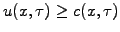 .
.
SYLLABUS Previous: 6.2 Methods for American Up: 6.2 Methods for American Next: 6.2.2 Solution of the


![$\displaystyle d\Pi=\left[ \frac{\partial V}{\partial t} +\frac{1}{2}\sigma^2 S^...
...l^2 V}{\partial S^2} -D_0 S\frac{\partial V}{\partial S} \right] dt \le r\Pi dt$](s6img53.gif)